Why in this step, we don’t want to make -5 to be 0 by multipling row 2 five times and add to row 3, which becomes 0,5,0,-5
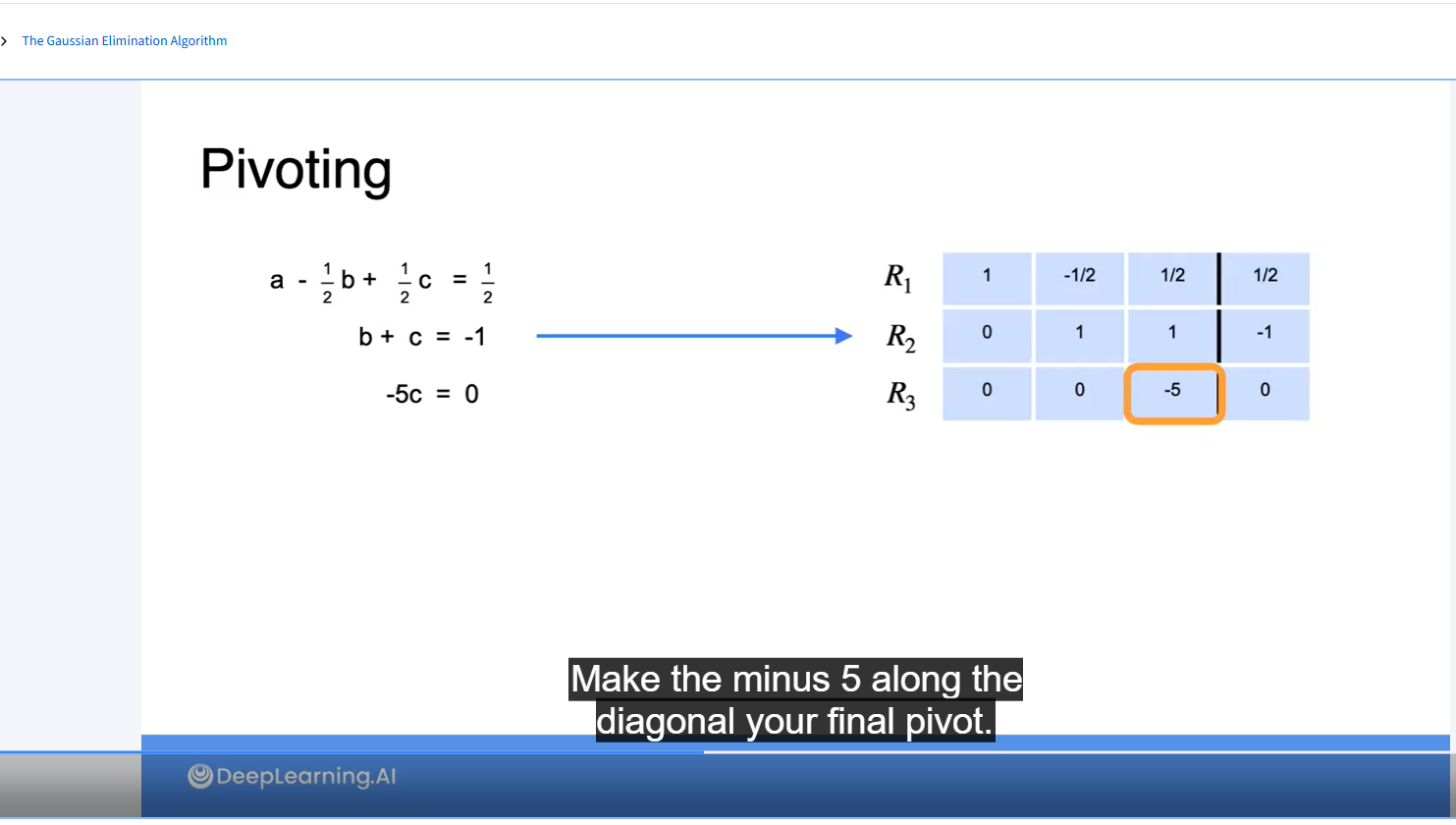
Because that would not give us a result in row echelon form, right? You’d have position (2,1) as non-zero.
1 Like
But the definition of row echelon form is that zeros should be at bottom so even -5 is 0, that matrix still satisfy requirement as row echelon form.
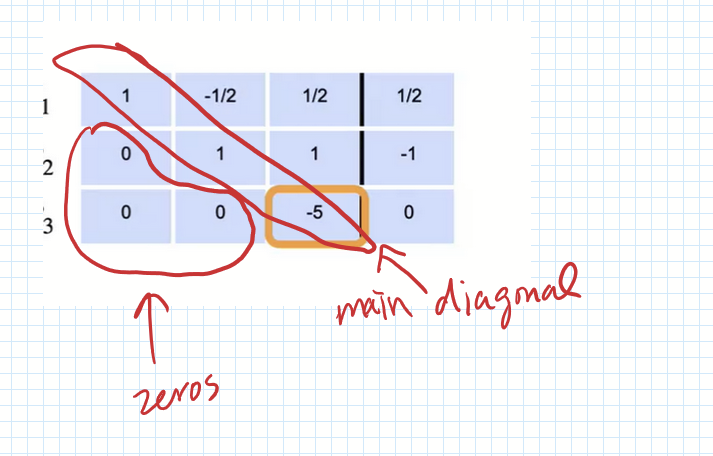
Sorry, but I must be missing your point. I think you should take another look at the definition of row echelon form. All elements below and to the left of the main diagonal must be zero, right?
yes, but if the last row is all 0, it still satisfies as row echelon form. no?
Yes, but look at what you said in your first post. If you do what you suggest there, you end up with [0 5 0] as the last row, which does not mean that criterion, right?
What am I missing in what you are saying?
no, that last row will become 0,0,0.
It will be 0 5 0, and you said so yourself.
ah sorry, I confused myself. yes, it becomes 0,5,0, and it’s not row echelon form anymore, because the 1 on row 2 column 2 should have 0 under it instead of 5?
That’s right. As Paul said, for it to be row echelon form, all elements below and to the left of the main diagonal have to be zero.
1 Like
and the number on the main diagonal doesn’t have to be all non-zeros right?
No, they don’t have to be non-zero.